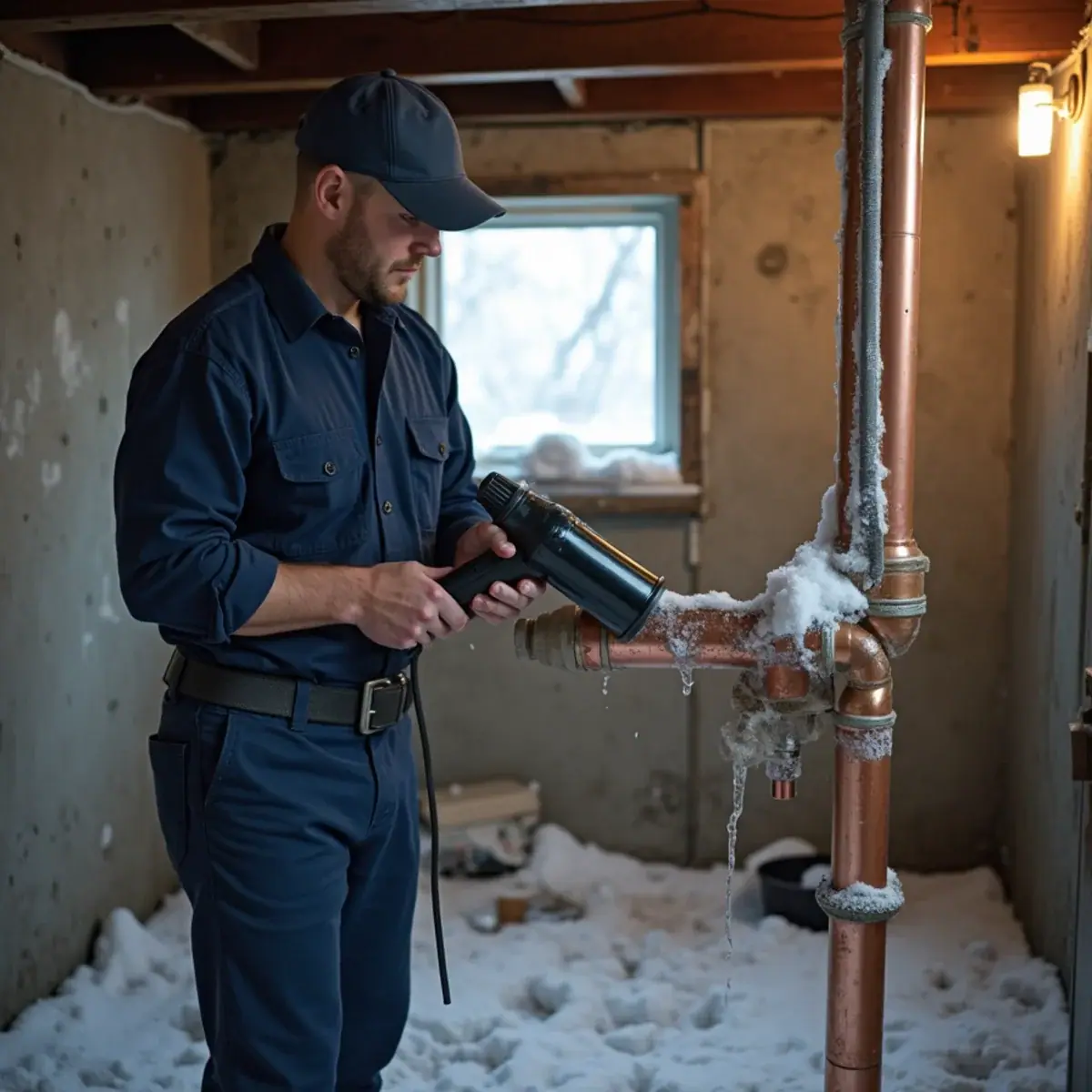
If a faucet gives you a trickle or nothing on a subzero morning, a pipe is probably frozen. Open that faucet, find the cold section of pipe, and warm it gently with a hair dryer, heating pad or a space heater set well back. Never use a torch or open flame. If you cannot find the frozen spot, or you see water, shut off the main valve and call (858) 363-8298 so we can send a licensed plumber.
Thawing is only half the job. A pipe that froze may already be split, and the leak only shows up once the ice melts. Here is how to handle both, and how to keep a Chicago-area winter from doing it again.
How to tell a pipe is frozen
- One faucet or fixture has little or no flow while others work normally.
- The toilet tank refills slowly or not at all.
- Frost is visible on an exposed pipe, or the pipe feels ice cold compared with the rest of the line.
- You hear a faint whistle or nothing at all when you open the tap.
If no fixture in the house has water, the freeze is more likely at the water meter or where the service line enters the basement. That is a call for a plumber, not a hair dryer.
Where pipes freeze in Villa Park and DuPage homes
The median Villa Park house was built around 1958, and the ranches, Cape Cods and split-levels from that era share the same weak spots. Freezes almost always happen where a pipe runs close to outside air.
- The rim joist at the top of the basement wall, where the sill plate is drafty and supply lines run to an outdoor faucet.
- Kitchen sink lines on an exterior wall, especially in a cabinet with no heat register.
- Pipes in crawl spaces under additions, sunrooms and back porches.
- Lines through an attached garage or over an unheated breezeway.
- Old sill cocks (outdoor faucets) that were never shut off and drained for the season.
Galvanized steel supply pipe, still common in pre-1960 homes, is already narrowed by rust inside, so it freezes shut sooner and splits at its threaded joints. Older homes around the area, including the historic houses we see in Glen Ellyn, add plaster walls and uninsulated bays that hide the pipe until it leaks.
How to thaw a frozen pipe safely
- Open the faucet the frozen pipe feeds, both hot and cold. Running water helps melt the ice, and an open tap relieves pressure.
- Find the frozen section by following the pipe from the faucet back toward the basement, feeling for the coldest spot.
- Warm the pipe starting near the faucet and working back toward the ice, so melting water has somewhere to go.
- Use a hair dryer, an electric heating pad or towels soaked in hot water. A space heater works if it is kept well away from anything that can burn and never left alone.
- Keep warming until full flow returns, then check the whole run for drips.
Never use an open flame
Propane torches, heat guns held close and kerosene heaters start house fires every winter, often inside walls where the fire is not seen until it spreads. They can also boil the water trapped in the pipe and burst it. Do not use electrical appliances near standing water.
If the frozen section is inside a finished wall or ceiling, raise the room temperature and open the cabinet or access panel nearest the pipe. If that does not work within an hour or so, a plumber can locate and thaw it without tearing into more wall than needed.
Why a frozen pipe splits somewhere other than the ice
Ice rarely bursts a pipe by pushing on the wall where it forms. Research by the University of Illinois Building Research Council found the damage comes from pressure: once an ice plug seals the pipe, more ice keeps forming and squeezes the water trapped between the plug and the closed faucet. Upstream of the plug, water can retreat toward the meter, so nothing builds up there. The split usually opens where there is little or no ice.
So after a thaw, check the whole run between the frozen spot and the faucet it feeds, not only the frosty section you warmed. And open the tap first: it gives that trapped water somewhere to go.
| Myth | What actually happens |
|---|---|
| The pipe bursts where the ice is | Pressure builds downstream of the ice plug, so the break is usually in a stretch with little or no ice |
| A dripping faucet keeps the water from freezing | Water can still freeze with a slow drip. The open tap works by relieving pressure, so if the drip stops overnight, leave the faucet open: the line has probably frozen and still needs that relief |
Moving air is the part most people miss. A draft through a gap where a cable or phone line enters the rim joist chills a pipe far faster than still cold air, which is why a pipe can freeze in a heated house. Older frame houses with supply lines in outside walls, like those near downtown Westmont, freeze at those gaps first.
If the pipe bursts: shut off the main first
Find your main shut-off before you need it. In most Villa Park basements it sits on the front foundation wall, right where the water service comes through the floor or wall, next to the water meter. Older homes often have a gate valve with a round handle; newer ones have a quarter-turn ball valve.
Turn it clockwise until it stops. Old gate valves sometimes seize or break when turned after years of sitting, so do not force it with a wrench. If it will not close, call us and tell the dispatcher water is running; our 24/7 emergency plumbers handle burst pipes day and night.
Once the water is off, open a low faucet to drain the lines, move valuables away from the leak and turn off power to any circuit where water is reaching lights or outlets. Take photos for your insurance company.
Repairing a split or cracked pipe
A split copper line is usually cut out and replaced with a new section. A frozen galvanized run often cracks at the fittings, and the plumber may recommend replacing more of it with copper or PEX rather than patching a pipe that is rusted through elsewhere. The plumber inspects, explains the choice and gives a price before starting. Our plumbing repair service covers pipe leaks, seized shut-off valves and replacing old galvanized lines.
Every plumber we send is licensed and insured in Illinois.
How to keep pipes from freezing next winter
Before the first hard freeze
- Disconnect garden hoses, then shut off the inside valve for each sill cock and open the outdoor faucet to drain it. Frost-free sill cocks still need the hose removed.
- Insulate pipes along the rim joist and in unheated spaces with foam pipe sleeves.
- Seal gaps where pipes, wires and dryer vents pass through the rim joist.
- Point the sump pump discharge so it drains freely; frozen discharge lines are a common winter call here. A freeze-relief fitting lets water spill out by the house if the line beyond it ices over. If the pump runs nonstop or not at all, see why a sump pump runs constantly.
During a cold snap
- Let faucets on exterior walls drip, both hot and cold.
- Open sink cabinet doors so room heat reaches the pipes.
- Keep the thermostat at 55°F or higher, day and night, even if you leave town.
- Keep the garage door closed if water lines run through the garage.
Leaving the house for a week in January
Turning the heat far down while you travel is how pipes that never froze before split. Keep the heat on, and for a long trip drain the system, the surest safeguard, since an empty pipe has nothing to freeze:
- Close the main shut-off at the meter.
- Open every faucet, tub and shower valve, hot and cold, until the water stops, and flush each toilet once.
- The taps can be closed again; lines full of air do not need them open.
- On your return, open the main slowly and run each fixture until it stops spitting air.
Lake Michigan water, delivered here through the DuPage Water Commission, comes into the house much colder in January than in summer, so pipes near cold walls have less margin than homeowners expect. If the same pipe freezes every year, have a plumber reroute it inside the heated space instead of fighting it each winter. A burst supply line is also one of the few times basement water is clean water; for sewage coming up the floor drain, see what to do when the sewer backs up. When the thaw comes, our spring storm basement checklist covers what to check next.
Questions we hear about this
Should I leave the faucet dripping overnight?
Yes, on nights well below zero, for faucets on exterior walls or pipes that have frozen before. A slow drip of both hot and cold keeps water moving and relieves pressure if ice starts to form. It will not protect a pipe in a completely unheated space, so insulation and sealing drafts still matter.
How long does it take a frozen pipe to burst?
There is no set time. A pipe can split within hours in subzero wind or hold for days in milder cold, depending on the pipe material, how exposed it is and how full it is. The damage usually shows when the ice melts, so watch a thawed pipe closely for drips for the first hour.
Is heat tape safe to use on pipes that keep freezing?
It can be, if it is made for water pipes and installed exactly as the maker's instructions say, because misused heat cable can start a fire. Models with a built-in thermostat switch on by themselves when the pipe gets cold; plain ones must be plugged in each time and are easy to forget. For a pipe that freezes every winter, rerouting it into heated space is the lasting fix.